
Process
Bringing the vision to life.
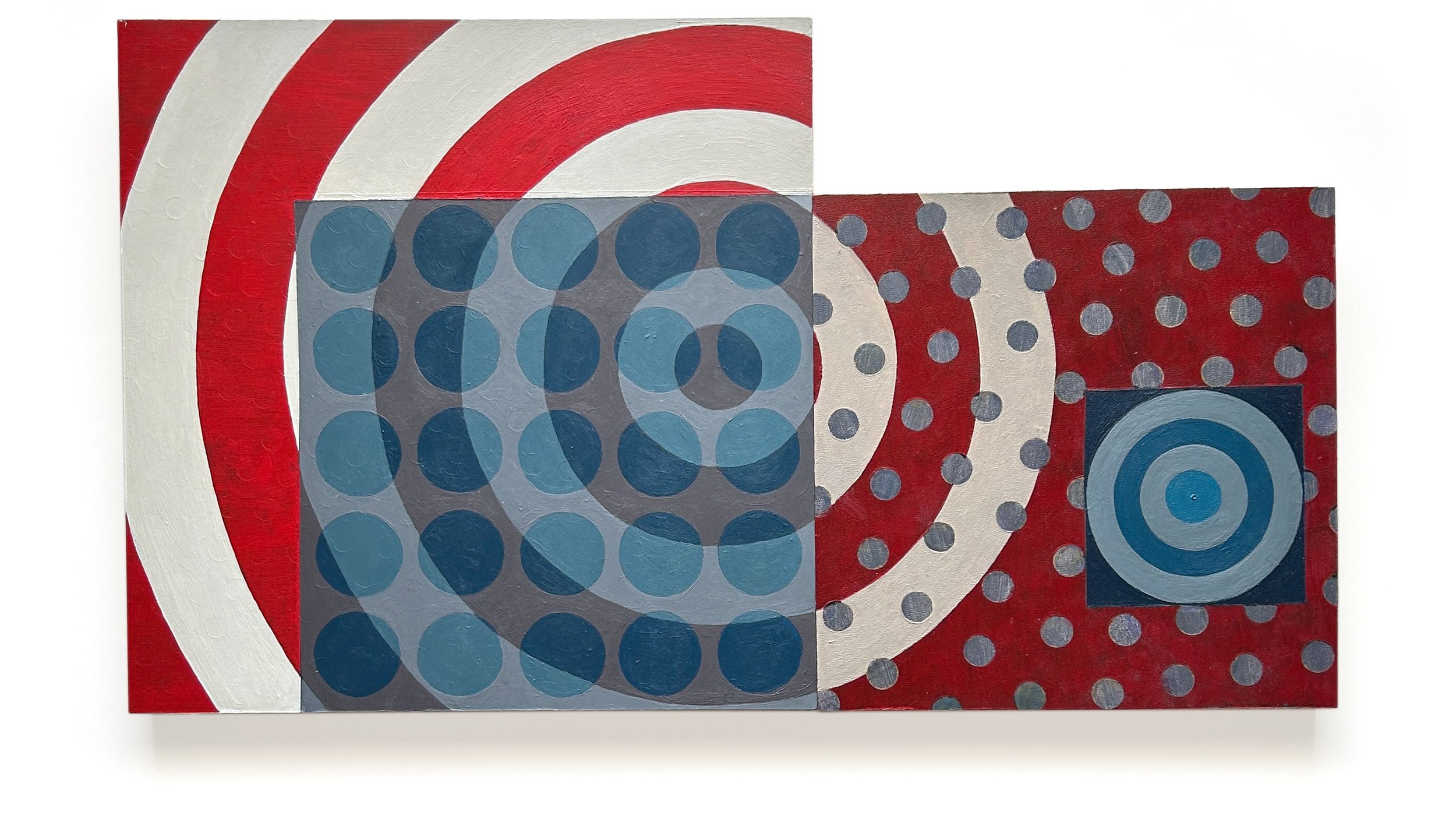

The painting process
I start without preconceived ideas or sketches. I do use recurring elements - like circles, stripes & checkerboards - but I recombine these in different ways each time - searching for something surprising to happen that I couldn’t have planned.
I love working with acrylic paint because it dries quickly, making it easy to repaint over and over. Often my compositions changes drastically before they’re completed.
Acrylics also give me immediate control over color. After a minute or two of drying time, I see exactly what a hue looks like in its surroundings, and if I don’t like the result I can overpaint til I get what I want. The right color, for instance, can give the effect of transparency. Sometimes I purposely choose colors I don’t like and combine them with other colors I don’t like, to get beyond my biases.
Techniques which come from my background as a screenprint artist influence my painting process. For instance, I use stickers and tape to mask areas before painting and then remove the mask to reveal layers beneath. Patterns build up as a result and give a sense of depth to the flat surface. Where shapes appear to float on top, or where it seems we’re looking through openings at something further back.
I paint simultaneously on several separate panels. They may gradually combine to form one continuous rectangle or shape, or remain separate but dialogue with each other. Sometimes new panels get added to resolve the composition, or a panel may suggest a different plane from the rest and enhance the sense of layers and deeper space.
I sometimes use the computer to test things out. Especially when a painting is close to being finished but something is missing, I hesitate to overpaint complex areas that would be hard to reproduce. That’s when I bring a photo of the piece into a graphics program, where I add layers to try out ideas. When I get what I want I’ll go paint that.
For all these reasons I look forward to the challenge of every new painting.

The ceramics process
My starting point is to create white porcelain forms on the potters wheel, and my goal is to find shapes that lend themselves to particular surface treatments. Later they're painted with patterns. So, for instance, creating a curved shape with edges will bend a pattern to give it an optical sense of movement. The design is painted with underglaze, but only after the raw piece has been fired at low temperature and is less fragile, and the final step is to spray with clear glaze and fire a second time at high temperature, which makes the surface nonporous.

A form is created on the wheel…

…next it’s hand painted with underglaze…

…finally it’s glazed & put through final firing.
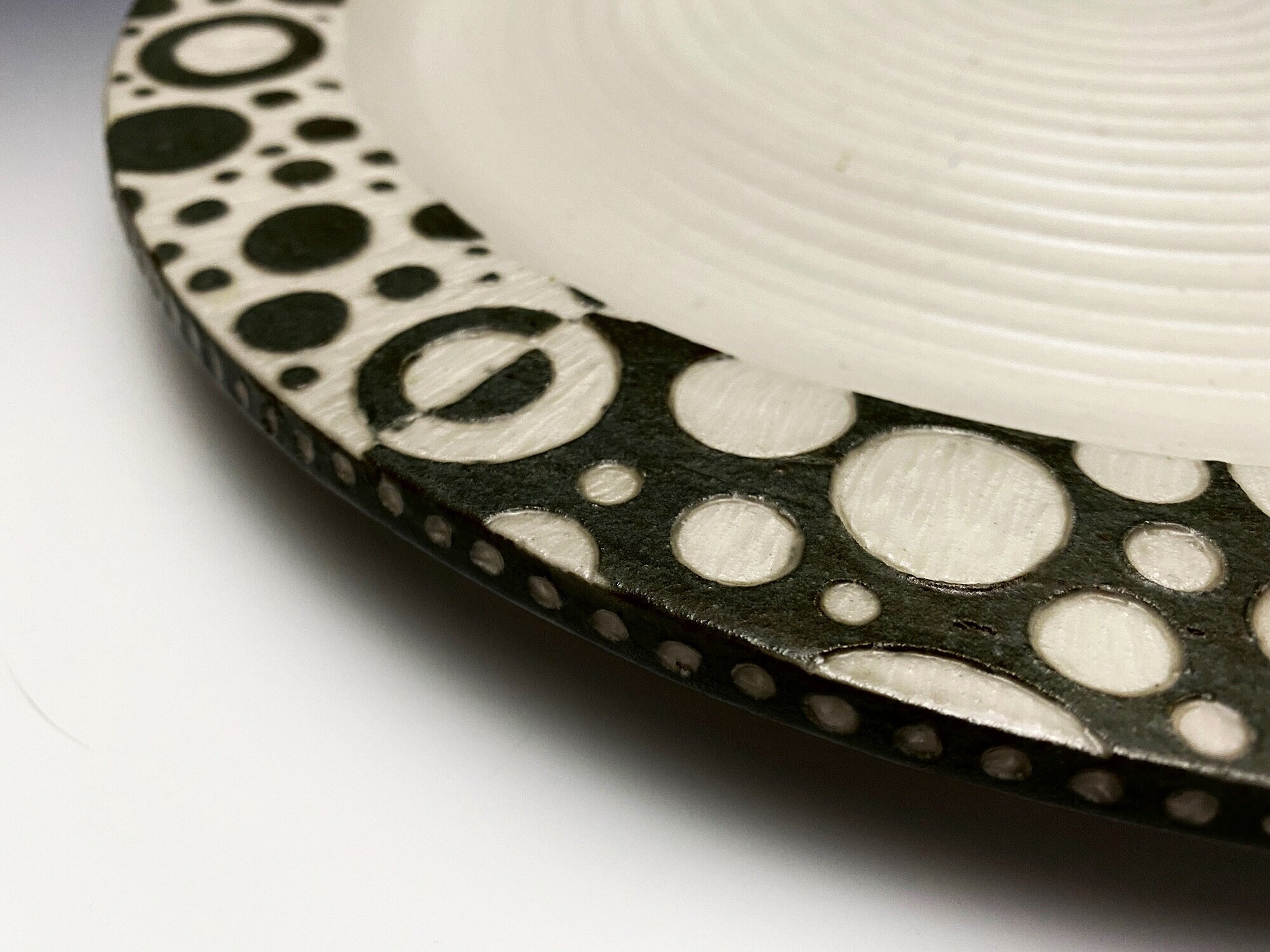
Sgraffito patterning
The term “sgraffito” comes from an Italian word meaning “to scratch”. The artist paints a layer of liquid colored clay, called slip, onto a freshly made ceramic piece, then scratches through to reveal parts of the underlying clay body. Susan uses colored slips over white porcelain clay.
Get in touch
Questions, inquiries, or just want to find out more?